| How the Jew Saved Christmas: A New Christmas Tale Chuck Palahniuk 4/5 |
 First Sentence "It's a classic." |
| Publisher's Description: Short story published on BlackBook. http://www.bbook.com/jew-saved-christmas/ |
|
Dear Reader, First off, this short story is FREE! Click HERE! One of things I love the most about Palahniuk is his short stories, mostly because he almost always posts them online for free. You have to love the guy for giving us a piece of him pro bono. It also satisfies my craving for something unusually disturbing every now and then (Palahniuk fans will know what I'm talking about). This story was about a girl working retail during the Holidays. Chuck really goes all out and describes every little horrid detail perfectly, right down to the workplace cubby holes. It took me back in time to those days when I used to slave weekends for corporate retail. I hated working during the Holidays, it was always a terrible mess of mass consumers running around like chickens with their heads chopped off. Terrible, just terrible. I'd imagine things haven't changed much since those days and more than likely have gotten ten times worse. The ironic thing about this story is that is shows us commercialism and consumerism at large WITHIN the retail store employee secret Santa exchange. To top this all off we have a little investigative mystery going on with one of the secret Santa gifts. Without giving too much away, there is a part of the story where a "food" related secret Santa gift is scrutinized. I can relate to this because working in the healthcare industry, every now and then a patient will bring us a yummy treat. The rule of thumb in the workplace is usually, "If cooked by the patient, throw or give to someone else. If bought, eat away!" I didn't understand this secret rule of thumb until someone pointed out that you could never truly know what the kitchen it was cooked in looks like. My imagination started going wild and from there on out... I just can't eat gifted food from strangers without thinking of bug infested kitchens. Moving on... the surprise at the end really throws that pie in your face, saying "See! You didn't see that one coming?!" How silly people are with Christmas and gifts, I just wish everyone could see what a problem it has become. Frankly, I applaud this story for Palahniuk slapping us in the face with it. Just read it! It's short, sweet with a surprise ending. Happy Reading, AmberBug |
|

Wednesday, January 8, 2014
How the Jew Saved Christmas: A New Christmas Tale

Friday, January 3, 2014
Les Misérables
| Les Misérables Victor Hugo, Norman Denny (Translator) 5/5 |
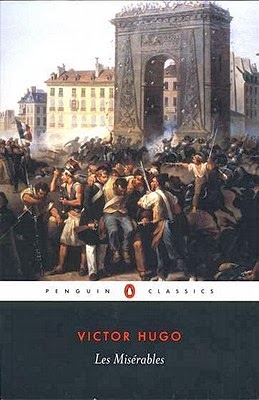 First Sentence (Preface from Original Publisher) "So long as there shall exist, by virtue of law and custom, decrees of damnation pronounced by society, artificially creating hells amid the civilization of earth, and adding the element of human fate to divine destiny; so long as the three great problems of the century - the degradation of man through pauperism, the corruption of woman through hunger, the crippling of children through lack of light - are unsolved: so long as social asphyxia is possible in any part of the world; - in other words, and with a still wider significance, so long as ignorance and poverty exist on earth, books of the nature of Les Miserables cannot fail to be of use."
|
Publisher's Description:
‘He was no longer Jean Valjean, but No. 24601’
Victor Hugo’s tale of injustice, heroism and love follows the fortunes of Jean Valjean, an escaped convict determined to put his criminal past behind him. But his attempts to become a respected member of the community are constantly put under threat: by his own conscience, when, owing to a case of mistaken identity, another man is arrested in his place; and by the relentless investigations of the dogged policeman Javert. It is not simply for himself that Valjean must stay free, however, for he has sworn to protect the baby daughter of Fantine, driven to prostitution by poverty. A compelling and compassionate view of the victims of early nineteenth-century French society, Les Misérablesis a novel on an epic scale, moving inexorably from the eve of the battle of Waterloo to the July Revolution of 1830.
Norman Denny’s introduction to his lively English translation discusses Hugo’s political and artistic aims in writing Les Misérables.
|
|
Dear Reader, This epic novel by Victor Hugo was quite surprising a treat. I think the enchantment felt was partially due to the lack of knowledge I had of this popular story. I've never seem any of the films or ventured out to see the play. Anyone who has ever read this will know Hugo tends to digress into many topics which stray from the story itself. Not knowing this, the first digression choked me like swallowing on a huge pill. But slowly, after each one... I started to enjoy his digressions and actually wanted more. Hugo has a wonderful mind and really delves into some thought provoking ideas. All this stimulating writing has me highlighting like crazy. For example, I loved the way Hugo compared a prison to a monastery and a convict to a nun, never would I have even thought to compare the two, but what a comparison it is!! I also loved the entire rant on slang; this topic is still being debated today. The slang of long ago is proper speech today which strengthens the argument even more. He brings a refreshing look at what slang really is and how it should be treated. Progress... we must be open to it. One of my favorite characters in the book was actually a very minor character but one which brought about Hugo's rant of slang. Gavroche, the street urchin who creates a nest in an elephant sculpture, has such cheer and resourcefulness for a child with nothing. This is admirable but Gavroche's true charm lies with his slangy speech. He speaks chock full of cute world for ordinary things and he always corrects others when they use "proper" speech. His part is short but his character is so heartwarming and odd that it stuck with me. Okay, so... this story is aptly names, "The Miserable Wretches", be warned! EVERYONE has horrible things happen to them! However, I think a happy ending is quite overrated and usually enjoy the nitty gritty truth better. I'll leave you with this quote straight out of the ending of the book: "It is a terrible thing to be happy! how content one is! How all-sufficient one finds it! How, being in possession of the false object of life, happiness, one forgets the true object, duty!" It was Hugo's duty to deliver us a story with depth and feeling (not one of those dull, heard it all before stories). With this, he has success... END of story. Happy Reading, AmberBug |
|
Thursday, January 2, 2014
The Forgotten Garden
| The Forgotten Garden Kate Morton 5 / 5 |
 First Sentences "It was dark where she was crouched but the little girl did as she'd been told. The lady had said to wait, it wasn't safe yet, they had to be as quiet as larder mice. It was a game, just like hide-and-seek." |
| Publisher's Description: A foundling, an old book of dark fairy tales, a secret garden, an aristocratic family, a love denied, and a mystery. The Forgotten Garden is a captivating, atmospheric and compulsively readable story of the past, secrets, family and memory from the international best-selling author Kate Morton. Cassandra is lost, alone and grieving. Her much loved grandmother, Nell, has just died and Cassandra, her life already shaken by a tragic accident ten years ago, feels like she has lost everything dear to her. But an unexpected and mysterious bequest from Nell turns Cassandra's life upside down and ends up challenging everything she thought she knew about herself and her family. Inheriting a book of dark and intriguing fairytales written by Eliza Makepeace - the Victorian authoress who disappeared mysteriously in the early twentieth century - Cassandra takes her courage in both hands to follow in the footsteps of Nell on a quest to find out the truth about their history, their family and their past; little knowing that in the process, she will also discover a new life for herself. |
|
Dear Reader,
Wow. I just LOVED this book. I can't think of anything that was wrong with it. It was an adventure story, a mystery, a family saga, and much more, all rolled into one. Oh, and I can't forget: it was also a fairy tale of sorts, and fairy tales play a very large part in this book.
The premise is that there is a very young girl who is found on the docks of a port in Australia in 1913. She has no memory of her past, and no idea who or where her parents are. The things she carries with her lend no clues to her identity. Therefore, the harbormaster takes her in and eventually he and his wife adopt the child as their own. Over the years, Nell grows up believing she is their daughter. When she is finally told the truth of her origins - or rather, her lack of them - her world is turned upside down. She begins a quest to learn the truth of her heritage.
The book jumps back and forth between a turn-of-the-century story about a destitute young girl trying to survive in a corrupt London, daily life in a lord's manor house at around that same time, a 1975 trip which Nell takes to the England town where she believes she has roots, and another 2005 trip which her granddaughter Cass makes to dig deeper into the mystery. I love all of the layers and the wonderful writing style which Morton employs. Her characters are real, very multi-dimensional, and truly sympathetic - even when some of them become corrupted, that just makes them more human. The whole book feels like something of a fairy tale, and very magical, even though the entire book is at the same time totally realistic. I think it's more the way the book is framed, and how the tale unfolds. It's as if Morton has written something of a modern-day fairy tale.
I don't know if I've mentioned how I do things regarding my bookshelves, but my general rule is that if I truly love a book, I want to own a copy for myself. That way, I can return to it (although I rarely reread) or lend it, or simply see it and smile at an old and happy friend. I definitely plan to aquire for myself a copy of this book. One of the best I've read in a while. Beautiful and enchanting. I didn't want it to end.
Yours,
Arianna |
|
Wednesday, January 1, 2014

Tuesday, December 31, 2013
A Tale for the Time Being - Review by AmberBug
| A Tale for the Time Being Ruth Ozeki 3/5 |
 First Sentences"Hi! My name is Nao and I am a time being." |
| Publisher's Description: In Tokyo, sixteen-year-old Nao has decided there’s only one escape from her aching loneliness and her classmates’ bullying. But before she ends it all, Nao plans to document the life of her great-grandmother, a Buddhist nun who’s lived more than a century. A diary is Nao’s only solace—and will touch lives in a ways she can scarcely imagine. Across the Pacific, we meet Ruth, a novelist living on a remote island who discovers a collection of artifacts washed ashore in a Hello Kitty lunchbox—possibly debris from the devastating 2011 tsunami. As the mystery of its contents unfolds, Ruth is pulled into the past, into Nao’s drama and her unknown fate, and forward into her own future. Full of Ozeki’s signature humour and deeply engaged with the relationship between writer and reader, past and present, fact and fiction, quantum physics, history, and myth, A Tale for the Time Being is a brilliantly inventive, beguiling story of our shared humanity and the search for home. |
|
Dear Reader, This book was chosen for me not by me. There is a quaint bookstore down by the shore in Connecticut (might have mentioned this place before) that convinced me to sign up for a monthly club that sends you signed first edition hardcovers for only the price of the book itself. I absolutely love this deal because it makes me branch out and read something I might have otherwise left alone. Although Ozeki's novel didn't speak to me the way it did to others, I still feel like RJ Julia selected this book with care and the writing and imagination is most definitely there. A Tale for the Time Being does have a large number of readers who LOVED every word. The story is essentially two interconnected stories in one. You have the plot line with Nao, sixteen years old and going through all the troubles a truly unique girl at that age would have to go through (if not a little more). The parts with Nao as the main focus really kept me reading and I loved almost all of it. The second story follows a couple that has some problems. We have Ruth, who becomes obsessed with this story of Nao that happened to wash up on the shore. Such a romantic idea, which I loved. However, the interaction between her and the husband had me cringing. I absolutely HATED the dynamic between the two, they didn't play nice with one another and ended up making me feel awkward (the kind of awkward feeling that comes when you happen upon a very heated lovers spat and you wish you could disappear into the wall before they bring you into it... yes that!) Don't get me wrong, I did like this book for the most part but I had way to many dislikes to give this any higher of a rating. When I liked something in the book, I LOVED it but the same goes for when I didn't like something, it turned into an extreme DISLIKE. Now to get into the gritty ending and for this I have to say goodbye to those who haven't read the book. SPOILER ALERT! DON'T READ THE RED TEXT BELOW IF YOU HAVEN'T READ THE BOOK!!! What the heck was up with that crazy explanation to tie up the ending to make it clean and happy!? I hated it. I would rather have a sad ending instead of a crazy one! It explained everything so vaguely with parallel worlds and quantum mechanics. I love sci-fi, watched every season of Stargate (also with many episodes on quantum mechanics and parallel worlds) BUT the difference being... I didn't feel it has a place in this book, it didn't really fall into place and the explanation was held by such a small thread it broke when I turned the page in the book. SPOILER IS OVER! YOU CAN CONTINUE READING!!! The three stars I gave this book was for Nao and her heartwarming, compelling story that kept me reading for the entire four hundred and thirty two pages. I warn you that this is not for everyone (especially with that ending) but at least you'll have a nice journey getting there. Yours, AmberBug P.S. - Check out what Arianna thought of this book! | |
Thursday, December 26, 2013
A Tale for the Time Being
| A Tale for the Time Being Ruth Ozeki 4 / 5 |
 First Sentences "Hi! My name is Nao and I am a time being." |
| Publisher's Description: In Tokyo, sixteen-year-old Nao has decided there’s only one escape from her aching loneliness and her classmates’ bullying. But before she ends it all, Nao plans to document the life of her great-grandmother, a Buddhist nun who’s lived more than a century. A diary is Nao’s only solace—and will touch lives in a ways she can scarcely imagine. Across the Pacific, we meet Ruth, a novelist living on a remote island who discovers a collection of artifacts washed ashore in a Hello Kitty lunchbox—possibly debris from the devastating 2011 tsunami. As the mystery of its contents unfolds, Ruth is pulled into the past, into Nao’s drama and her unknown fate, and forward into her own future. Full of Ozeki’s signature humour and deeply engaged with the relationship between writer and reader, past and present, fact and fiction, quantum physics, history, and myth, A Tale for the Time Being is a brilliantly inventive, beguiling story of our shared humanity and the search for home. |
|
| Dear Reader, Boy, am I slacking! I'm so sorry. I finished this book on December 17, but I didn't feel like writing a review for a while, as I was trying to figure out how I felt about this book. Also, I audiobooked it while driving to & from work, which means that sometimes I finish a book mid-commute and will start another, and then when I get home I'm no longer in the mood to write a review. Blerg! (We won't even get into how I've finished ANOTHER audiobook since this one, and also have to write THAT review...) In ANY case, hmm. What DID I think of this book? Well, ultimately (and for like 90% of the book), I did love it. Ozeki told a great and very enthralling story of a girl who lives in Japan and writes regularly in her diary about her life, her family (past and present), and her feelings. That part was fantastic, and I never wanted to pause when I was reading about Naoko. However, Nao's stories are interspersed between those which describe a woman (Ruth, which makes you wonder how autobiographical the novel is) who found Nao's journal years after it was written, and who reads the diary entries obsessively and convinces herself that she can "save" Nao, somehow - even though she doesn't even know what has since happened to the girl. The "Ruth parts" of the book were significantly less engaging than Nao's, and contained a lot of very annoying characters, but I didn't find them off-putting enough that it ruined the book as a whole, and I did appreciate the device the author used in order to create suspense and a larger story. The problem is, really, that I don't like fantastical books. Perhaps that's not the right term - maybe it's more "surreal"? I love fantasy, if it's placed into a fantasy world or framed as such. Just not when it's shoved into an otherwise realistic novel, a la Toni Morrison. And Amber had warned me that this book hit a point where it just...went a bit off. I found the worst to be the dream that Ruth found herself having, which had quite wide-reaching effects for it being all in her head. And the parts about how the journal changed. What didn't bother me, though, was the science with which the book ended. I mean, it's science, and it's feasible, in its own rational way. And I kind of liked how Ozeki introduced the scientific element into her very fanciful novel. But it did seem very strange to tack it on at the end there, and to kind of devolve from a novel into a (very superficial and simplified) scientific text for a few pages before ending. That just didn't sit right - perhaps I would have felt better if there were hints throughout the book of this, or even just more discussion about the phenomenon as a whole, but it just wasn't working for me, in the long run. Hence, while this was a 5-star book for the majority of the story (I particularly loved the POV parts about Nao's great-uncle who served as a reluctant kamikaze pilot in WWII), it ended up dropping down a star in my eyes, for the way it ultimately ended. I do waffle; perhaps it should be close to 4.5, for me. But, I'm going to leave my initial rating as-is. And, I would very much recommend this book for the first 90% of it. Please do keep that in mind - I certainly didn't hate it! It just threw me for a loop, is all. Yours, Arianna |
|
Tuesday, December 10, 2013
The Will
| The Will Harvey Swados 4 / 5 |
 First Sentence "When you were young and a friend died, Solomon Stark reflected as he steered absently through the slush on the road to the municipal airport, you wept; but when you were past seventy, the tears did not come so easily, even though the loss was correspondingly greater." |
| Publisher's Description: Brothers Leo and Max Land came to America from Romania in 1911, but they took different paths in pursuit of the American dream. Even as they worked together, Max sought out material things while Leo made a simple, private life for himself. Now, after the death of both brothers, Leo’s three sons—the only surviving heirs—learn that they stand to inherit a fortune. As they battle for control, they come to expose their own deeply complicated visions of success in America. The Will is a stunning portrait of American idealism crushed under the weight of material desires. |
|
| Dear Reader, You want to know the strangest thing? I was pretty blown away by this book, until I realized it was a reprint of a 1968 publication. Then, for some reason, it became slightly more so-so in my mind. Is that saying something about the state of novels in this day and age? Perhaps simply that things were written in a different way back then? I can't be sure. I just really would have been extremely impressed if someone, writing now, could have written the late '60s so well. Knowing that Swados was writing it during that time period made it less...magical, I guess? Less fanciful on the part of the author, I suppose. Despite how that happened, though, and even though this took me months and months to read (only because I was reading it as an e-book, and those tend to get lost in the shuffle from time to time!), it was still quite good. A very well-written book about a pretty quotidian story, really. I mean, there certainly wasn't serious originality in the book, I'd argue: it was the story of three brothers who return to their childhood home in order to stake their claim on a mysterious inheritance. The book examined their relationships with one another, with their loved ones, with the world at large (including several people who played large roles in their collective past). It was also a study of fatherhood, from both the point of view of the father and that of his three strikingly different sons. The sons were stories in and of themselves, and the reader got to spend a good chunk of time with each man, learning their motives and back-story. So in this way, it was a fantastic character study. And, the descriptions of the burgeoning city (suburbs somewhere outside of Chicago, I think?) in the postwar boom were wonderful. What a different time it was back then. The end of the book, however, was...pretty anticlimactic. I still am not sure what I think about it. It reminded me in a very loose and strange way of The Usual Suspects, where a big and supposedly game-changing secret is revealed only at the end. But it wasn't that mind-boggling to me, and it felt like Swados rushed the resolution of his book, choosing to leave all of the relationships (these that he had been developing as hero vs. foil throughout the novel, poised to be resolved) still entirely open-ended. I have to say, though, I did love the double nature of the title: of course, it refers to the actual document conferring inheritance, but I believe it also speaks strongly of the intense and stubborn personalities that all three of the brothers possessed - perhaps, in its own way, their true inheritance from their father and uncle, in the end. Yours, Arianna P.S. Support ShelfNotes! Buy your copy of The Will here: |
|
Subscribe to:
Posts (Atom)


