Showing posts with label immigrants. Show all posts

Tuesday, June 9, 2015

The Boston Girl


The Boston Girl
Anita Diamant
3.5 / 5


Published 2014

First Sentence
"Ava, sweetheart, if you ask me to talk about how I got to be the woman I am today, what do you think I'm going to say?"
Publisher's Description:
From the New York Times bestselling author of The Red Tent and Day After Night, comes an unforgettable coming-of-age novel about family ties and values, friendship and feminism told through the eyes of young Jewish woman growing up in Boston in the early twentieth century.

Addie Baum is The Boston Girl, born in 1900 to immigrant parents who were unprepared for and suspicious of America and its effect on their three daughters. Growing up in the North End, then a teeming multicultural neighborhood, Addie's intelligence and curiosity take her to a world her parents can't imagine - a world of short skirts, movies, celebrity culture and new opportunities for women. Addie wants to finish high school and dreams of going to college. She wants a career and to find true love.

Eighty-five-year-old Addie tells the story of her life to her twenty-two-year-old granddaughter, who has asked her "How did you get to be the woman you are today." She begins in 1915, the year she found her voice and made friends who would help shape the course of her life. From the one-room tenement apartment she shared with her parents and two sisters, to the library group for girls she joins at a neighborhood settlement house, to her first, disastrous love affair, Addie recalls her adventures with compassion for the naïve girl she was and a wicked sense of humor.

Written with the same attention to historical detail and emotional resonance that made Anita Diamant's previous novels bestsellers, The Boston Girl is a moving portrait of one woman’s complicated life in twentieth century America, and a fascinating look at a generation of women finding their places in a changing world.

Dear Reader,

I have had this book on my shelf for a few months, and actually partly picked it up so I would stop getting the Pushstars song stuck in my head every time I saw it. Plus, my sister (whose taste is uncannily similar to my own) really enjoyed it, and knowing Diamant from The Red Tent, I looked forward to seeing her writing in a more modern setting.

I was a little disappointed though, because I think I expected more North End Boston (the one-time home of me and my sisters, at various times) and the book certainly didn't focus too much on that place, although it got its mentions. The book takes place all over Boston, which I suppose is the reason it’s not called “The North End Girl”, and the author does the entire city justice - you can see her love for its history. 

I loved the conceptual notion of the main character, Addie: she was a strong, smart, independent first-generation American woman, who figured life out on her own terms. However, as much as I liked her and probably would have wanted to be her friend had I met her in real life, I felt as if there was something missing that didn't allow me to care about her as much as I would have liked. Granted, I couldn't put this book down; I sped through it in two days. But I was unable to entirely connect. Luckily, the story carries the reader along, and there is enough personality in the book from all of Addie’s family and friends that you still do grow to care to know what happens. While the point of the book is only really about the love Addie has for those she holds dear, I found myself tearing up a bit at the end. So that says something.

I found the chapter titles interesting: each was a significant sentence pulled from the following pages which embodied the spirit of what was being said. I am not quite sure how I felt about that style. Knowing how things were set up, though, I often found myself flipping back to see what sentence had been pulled from the preceding pages, and taking a moment to ponder the significance. I don’t recall if that is a Diamant idiosyncrasy or if it was just used for this book, but I do think it made me sit for a moment after every chapter to consider the important phrases. I think I liked that. 

Overall, the book was a lovely little portrait of a young Jewish girl finding her way in early 1900s Boston. I thought it was a charming story about family and independence. Certainly a great summer read for the beach or a long trip.

Yours,
Arianna


The Boston Girl

Support Shelf Notes! Purchase your copy of this book here:
Hardcover:
Kindle:

Monday, March 23, 2015

Orphan Train


Orphan Train
Christina Baker Kline
4 / 5


Published 2013

First Sentences
"I believe in ghosts. They're the ones who haunt us, the ones who have left us behind."
Publisher's Description:
Orphan Train is a gripping story of friendship and second chances from Christina Baker Kline, author of Bird in Hand and The Way Life Should Be.
Penobscot Indian Molly Ayer is close to “aging out” out of the foster care system. A community service position helping an elderly woman clean out her home is the only thing keeping Molly out of juvie and worse...
As she helps Vivian sort through her possessions and memories, Molly learns that she and Vivian aren’t as different as they seem to be. A young Irish immigrant orphaned in New York City, Vivian was put on a train to the Midwest with hundreds of other children whose destinies would be determined by luck and chance.
Molly discovers that she has the power to help Vivian find answers to mysteries that have haunted her for her entire life – answers that will ultimately free them both.
Rich in detail and epic in scope, Orphan Train by Christina Baker Kline is a powerful novel of upheaval and resilience, of unexpected friendship, and of the secrets we carry that keep us from finding out who we are.

Dear Reader,

"I've come to think that's what heaven is--a place in the memory of others where our best selves live on." - Kline, The Orphan Train

This book was recommended by my dad, so I put it on hold at the public library because we have similar taste in books. (Good taste, of course!) I wasn't certain what to expect from the book, even though I apparently had added it in my TBR list on Goodreads. But the combination of my own interest and my father's convinced me it was worth checking out. And, I ended up really enjoying it!

The main story - that of an Orphan Train rider - is framed by another, modern-day story of a girl who is also an orphan, and has been bounced around from foster home to foster home. Currently 17, Molly is in what she hopes is her last fostering situation, but she gets caught stealing and is at the mercy of the system yet again. However, her boyfriend intervenes on her behalf and convinces everyone that it is a better idea for her to do community service helping out a local woman than for Molly to be sent to juvie. So she begins what sounds like the boring job of cleaning out an elderly woman's attic. Turns out, though, that Molly and Vivian have a lot in common, and the women soon bond over their stories.

Molly's story was less intriguing to me, but Vivian's was fascinating to read. A young Irish immigrant, she was orphaned at a young age and taken in by this society which took children off the streets of New York City and brought them out to the midwest via train, offering them up for adoption at every stop. I had never heard of this phenomenon before, but it was a very real (and apparently reasonable) thing in the early 1900s. Alone and left to fend for themselves in a new world, the children were often abused, used as workhorses, neglected by the Aid Society. Few were lucky enough to find a happy family experience, and usually those who did were the babies. Anyone over a few years old was generally taken on as free labor. It sounds like an awful experience, and Kline really wrote it well. Vivian lived through some serious hells, but found her own happinesses, and her story was an amazing and charming read. And while I wasn't Molly's biggest fan, I did enjoy the way the two women bonded over their common life experiences and became quite close.

I don't feel as if I am expressing how much I enjoyed this book well enough. I don't think anything but reading can really do it justice. So please, when you want a relatively light but enchanting read, pick this one up.

Yours,
Arianna


Orphan Train

Support Shelf Notes! Purchase your copy of this book here:

Paperback:
Kindle:

Tuesday, December 10, 2013

The Will


The Will
Harvey Swados
4 / 5


Published 1968

First Sentence
"When you were young and a friend died, Solomon Stark reflected as he steered absently through the slush on the road to the municipal airport, you wept; but when you were past seventy, the tears did not come so easily, even though the loss was correspondingly greater."


Publisher's Description:

Brothers Leo and Max Land came to America from Romania in 1911, but they took different paths in pursuit of the American dream. Even as they worked together, Max sought out material things while Leo made a simple, private life for himself. Now, after the death of both brothers, Leo’s three sons—the only surviving heirs—learn that they stand to inherit a fortune. As they battle for control, they come to expose their own deeply complicated visions of success in America. The Will is a stunning portrait of American idealism crushed under the weight of material desires.
Dear Reader,

You want to know the strangest thing?  I was pretty blown away by this book, until I realized it was a reprint of a 1968 publication.  Then, for some reason, it became slightly more so-so in my mind.  Is that saying something about the state of novels in this day and age?  Perhaps simply that things were written in a different way back then?  I can't  be sure.  I just really would have been extremely impressed if someone, writing now, could have written the late '60s so well.  Knowing that Swados was writing it during that time period made it less...magical, I guess?  Less fanciful on the part of the author, I suppose.

Despite how that happened, though, and even though this took me months and months to read (only because I was reading it as an e-book, and those tend to get lost in the shuffle from time to time!), it was still quite good.  A very well-written book about a pretty quotidian story, really.  I mean, there certainly wasn't serious originality in the book, I'd argue: it was the story of three brothers who return to their childhood home in order to stake their claim on a mysterious inheritance.  The book examined their relationships with one another, with their loved ones, with the world at large (including several people who played large roles in their collective past).  It was also a study of fatherhood, from both the point of view of the father and that of his three strikingly different sons.  The sons were stories in and of themselves, and the reader got to spend a good chunk of time with each man, learning their motives and back-story.  So in this way, it was a fantastic character study. And, the descriptions of the burgeoning city (suburbs somewhere outside of Chicago, I think?) in the postwar boom were wonderful.  What a different time it was back then.  The end of the book, however, was...pretty anticlimactic.  I still am not sure what I think about it.  It reminded me in a very loose and strange way of The Usual Suspects, where a big and supposedly game-changing secret is revealed only at the end.  But it wasn't that mind-boggling to me, and it felt like Swados rushed the resolution of his book, choosing to leave all of the relationships (these that he had been developing as hero vs. foil throughout the novel, poised to be resolved) still entirely open-ended.

I have to say, though, I did love the double nature of the title: of course, it refers to the actual document conferring inheritance, but I believe it also speaks strongly of the intense and stubborn personalities that all three of the brothers possessed - perhaps, in its own way, their true inheritance from their father and uncle, in the end.

Yours,
Arianna

P.S. Support ShelfNotes!  Buy your copy of The Will here:

Friday, September 27, 2013

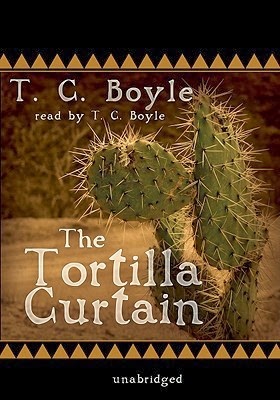
The Tortilla Curtain


The Tortilla Curtain
T.C. Boyle
4/5
Published 1995


First Sentence
"Afterward, he tried to reduce it to abstract terms, an accident in a world of accidents, the collision of opposing forces--the bumper of his car and that frail scrambling hunched-over form of a dark little man with a wild look in his eye--but he wasn't very successful."
Publisher's Description:
Read by the author.

The author of East Is East replays the tragi-comic meeting of representatives from two different cultures with nothing in common. This book calmly grabs hold with an unexpected suspense.

A Mexican illegal immigrant couple, Candido and America Rincon, seek a better life in Southern California. Candido's freak accident shows the couple's vulnerability and they are afraid to seek help. Each small improvement they are able to make in their daily existence, is quickly erased. They cross paths with Delany Mossbacher, a liberal nature writer who lives in a gated community in the same canyon. The story is artfully told from each character's point of view and the reader is torn between the shifting currents in each world. Cultural misunderstandings and tragic errors create the gripping realization that this may be one story without a perfect ending.

Dear Reader,

This is my first T.C. Boyle book, and it was a very interesting introduction to a novelist I've heard many good things about!  You might be wondering why I chose to read a book that was first published in 1995 and sometimes feels somewhat dated.  Well, it's largely because it was an audiobook, and available from my library's Overdrive offerings, so I figured I'd give it a go - I've been wanting to read Boyle for ages now, and I saw this and downloaded it.  Simple as that.  Like I said, it wasn't probably the best book to start with, but it's too late now, and besides - I still very much enjoyed reading it!  It was especially enjoyable to hear Boyle read his own work; I always prefer when authors narrate, because then I feel like I am truly getting to hear how they wanted every word to be read.

Some might find my initial comparison to David Foster Wallace odd, but it recalled strongly to me the feel of The Pale King, Wallace's posthumously-released (and never actually finished!) exploration into the life and history of an IRS employee.  Perhaps it was Boyle's attention to details about people which struck me as very similar to DFW.  In any case, that first impression didn't last the entire book, but it was something I wanted to make note of, in case anyone else enjoyed The Pale King as much as I did.

The story revolves around the lives of two very different couples - that of white, upper-middle-class Delaney and Kyra Mossbacher compared with that of almost-starving, illegal-immigrant Cándido Rincon and his young wife América.  Their lives cross paths suddenly and unexpectedly one day when Delaney mistakenly hits Cándido with his car as the latter was trying to cross the road.  From there, the story unfolds by taking turns alternating focus between all four of the main adult characters.  Delaney writes a nature column and is stay-at-home dad; he is generally a very laid-back and open-minded kind of guy.  Compare that with his wife Kyra, an ambitious real estate agent who longs for the safety and comfort she believes money can bring.  Meanwhile, the reader gets to delve into the tough and hand-to-mouth life that Cándido and América must endure; the one cannot work because he is hurt, so the other must take odd jobs as she can get them, even though women are much less desirable at the labor pool where all illegal Mexicans congregate every morning in order to offer up their low-cost services to the rich white gringos who want to keep as much of their own money as possible. 

The story begins simply as a recounting of both sides' passions, beliefs, and situations, but then begins to reveal itself for what it really is: a thorough examination of the racial tensions which tore through California during the late 90s.  It was especially interesting reading it as a native New Englander and self-proclaimed liberal, who never had to experience either side of such a difficult situation.  But I did find it fascinating alternating between feeling kind of "above" the Mossbachers' somewhat materialistic lifestyle, and feeling bad for the struggles that the Mexicans had to endure.  However, you do find yourself (or at least, I did!) understanding more about where each side is coming from.  Since the Mossbachers never really get to see what the Rincons are going through, it's easy to understand why they become upset and scared when they lose beloved pets and become victims of vandalizing.  And you can't help but feel a deep sense of tragedy for the Rincons and their situation, which feels like it is always impossible to dig out of, even when they get a break here and there.  

Ultimately, I got the impression that Boyle's novel was about the importance of communication.  The need for all of us not to jump to conclusions about people based simply on their appearance or their actions.  We can never know what situation we will find ourselves in; it does help to try to empathize as much as possible, I do believe.  I think the ending of the book was beautiful, even if it felt somewhat lacking initially - I couldn't believe it was the end, just like that! - but I found after thinking about it that I loved how it stopped where it did.  It left the reader with perhaps a bit of hope, or at least an open-ended question about what could have transpired thereafter. 

I would recommend this book to most readers, even despite some of its dated references and feel.  I think it's always a great idea to walk in someone else's shoes for a little while from time to time.

Happy Reading!
Yours,
Arianna
Related Posts Plugin for WordPress, Blogger...