Showing posts with label made into movie. Show all posts

Tuesday, September 4, 2018

Ready Player One


Ready Player One
By Ernest Cline
Rating


Published [2011]

First Sentence
"Everyone my age remembers where they were and what they were doing when they first heard about the contest
."
Publisher's Description:


In the year 2044, reality is an ugly place. The only time teenage Wade Watts really feels alive is when he's jacked into the virtual utopia known as the OASIS. Wade's devoted his life to studying the puzzles hidden within this world's digital confines—puzzles that are based on their creator's obsession with the pop culture of decades past and that promise massive power and fortune to whoever can unlock them.
   But when Wade stumbles upon the first clue, he finds himself beset by players willing to kill to take this ultimate prize. The race is on, and if Wade's going to survive, he'll have to win—and confront the real world he's always been so desperate to escape.

Dear Reader,

This book is one of my top ten favorites. I listened to it on Audible. It was narrated by Will Wheaton who played Wesley Crusher on the 1980s-90s Star Trek: The Next Generation. This book is a geek-fest for anyone who relished and rolled around in their youthful obsessions. Most interestingly the plot surrounds the history of video gaming. It also takes place in a future dystopian version of the world. I like that Cline make the destruction of the eco-system as the reason why the world is so messed up. Plausible and important to continue to bring the fore-front of readers minds'. I also love that he has virtual reality as the world in which everyone chooses to live their life. With the way that our current world is so engrossed in our technology it makes evolutionary sense that we will end up inside the technology. Those who have ended up on the outskirts of the cool crowd and who played (or still play D&D) and embraced their nerdiness, can completely relate to the main character, Wade Watts/Parzival. I learned so much about how video games evolved since Cline used-semi-historical fiction to build the world of Ready Player One. I also enjoyed the love story between Parzival and Art3mis. Teenage love with the high stakes of the contest. Art3mis is also an equal on this playing field with her knowledge and dedication to what may seem nerdy, I can relate and admire that with my own store of Star Trek, World of Warcraft and Buffy knowledge. I appreciated that the author had the protagonist, Wade utilize his new found money from sponsorship move into the city and set up his studio apartment with security and tech to allow him to maintain his quest. I like that they have a system in which a pizza can be delivered to you through a door slot without ever having to have human contact (if so desired.) Without going into to spoilers, because the movie version is quite different than the book version, I like the undercover lengths that Wade undergoes to achieve his goals and eventually win the contest.
Commentary on Movie vs Book. I enjoyed watching the movie in the theater. The trailers had really painted an amazing job on the amount of pop-culture references and Easter eggs and music choices to represent the world of James Halliday. I was disappointed in something such as how quickly Wade and Art3mis meet IRL in the movie since that was really the last 10 pages of the book. Shoto and Daito - uhhh he's not 11 year old kid, why do they speak English so fluently and the consequences are a little more depressing that what happened in the movie. Odgen Morrow's role in helping the kids towards the end of the movie was much more believable than what they had his character do in the movie. Overall I liked the book more than the movie- but isn't that usually the case?
Yours,
Marsha

Harry Potter and the Goblet of Fire (Harry Potter, #4)

Support Shelf Notes! Purchase your copy of this book here:

Monday, April 4, 2016

The Postman Always Rings Twice


The Postman Always Rings Twice
James M. Cain
4/5


Published 1934

First Sentence
"They threw me off the hay truck about noon."
Publisher's Description:
An amoral young tramp. A beautiful, sullen woman with an inconvenient husband. A problem that has only one grisly solution--a solution that only creates other problems that no one can ever solve. First published in 1934 and banned in Boston for its explosive mixture of violence and eroticism, The Postman Always Rings Twice is a classic of the roman noir. It established James M. Cain as a major novelist with an unsparing vision of America's bleak underside, and was acknowledged by Albert Camus as the model for The Stranger.

Dear Reader,

Can you believe I went into reading this book without ever watching any of the movies or knowing the plot line? Well, I did and you know what? I loved it. It might have been just because of that reason, I didn't know the plot. For anyone who does know the plot, you have to admit that it's pretty darn clever. You have a beautiful married woman who falls in love with a drifter who comes to work with her elderly and fat husband. The two elicit a love affair that turns into something more, plotting to get rid of the inconvenience of her marriage. What do you get when you put two terrible people together, make them fall in love and figure out ways to trust the untrustworthy? A really great story. That's what this is.

After reading the book, now I've got to see the movies (especially the 80's version that stars Jack Nicholson & Jessica Lange). Check out some photos from the movie below (the last picture is just so you can check out the young & beautiful Jessica Lange):

Lana Turner & John Garfield in the 1946 Movie Version

Jessica Lange & Jack Nicholson in the 1981 Movie Version

Look how adorable Jack & Jessica look! Love it!

She is so beautiful, Jessica Lange with her bewitching stare.

Just looking at those pictures makes me want to rush out and get the movies today! I would HIGHLY suggest reading this book before watching the films though. I read them unbiasedly, without certain Hollywood Actors in my mind (which is for the best in my opinion).

Back to the book, I want to mention the language James Cain uses. He wrote the character of Frank (the vagabond) as exactly the way you'd suspect. We didn't even need a description, the dialogue alone gives us a rich and colorful view of who Frank represents. The same can be said about most of the characters, especially Cora, which results in extremely well written characters that can stand out without much of a story. However, James Cain gives us that story, and... it's a really fun ride. I felt thrown back into that time period, I could even feel the gritty air surrounding them. Cora shows us the reality of a woman selecting her path in life (to marry and be secure or to be a vagabond herself and wonder where the next meal will come from). So much has changed, yet we still feel for her because the discrimination still exists today. I also fell in love with Frank, even though he's a pretty rotten scoundrel in many ways. I think it's the typical bad boy attitude that got to me. This love story, it's my kind of love story... dirty (not in the sexual way) and honest, the way real relationships depend on trust and hardships. After reading this, I want to check out some more from James Cain. At least I can be secure in knowing the characters will be brightly colored and easily pictured, which is something I truly appreciate in any Author.

Happy Reading,
AmberBug


Support Shelf Notes! Purchase your copy of The Postman Always Rings Twice here:

Monday, December 1, 2014

Blindness


Blindness
José Saramago
Translated by Giovanni Pontiero 
3/5


Published 1995

First Sentence
"The amber light came on."
Publisher's Description:
A city is hit by an epidemic of "white blindness" that spares no one. Authorities confine the blind to an empty mental hospital, but there the criminal element holds everyone captive, stealing food rations and assaulting women. There is one eyewitness to this nightmare who guides her charges—among them a boy with no mother, a girl with dark glasses, a dog of tears—through the barren streets, and their procession becomes as uncanny as the surroundings are harrowing. As Blindness reclaims the age-old story of a plague, it evokes the vivid and trembling horrors of the twentieth century, leaving readers with a powerful vision of the human spirit that's bound both by weakness and exhilarating strength.

Dear Reader,

This book has been sitting on my shelf for at least two years now and I finally broke down and picked it up. Don't think that the book sat on the shelf because I wasn't interested in it, on the contrary, I was so intrigued by it I didn't want the movie to spoil my experience. The movie came out in 2008 and apparently waiting worked because when I lifted this book off the shelf to read it, I had forgotten it was made into a movie until Arianna mentioned it. After that, it all started flooding back to me. Unfortunately, I liked the movie better! There I said it. Okay, so to be fair... I should pick up the movie and watch it again just to be absolutely positive my feelings stay the same on this, but I'm pretty sure the movie wins out on this one.

Why? Glad you asked. I believe the movie SPOILED my experience with this book. I hate to say it but sometimes that happens and I find it truly heartbreaking. Just like when a movie doesn't live up to the book, the same can be said vice versa. Now I know some of you will rebuke that the writing of the book is so phenomenal it stands out on its own... Ohhkay, but I'm on the fence about the writing. Obviously the Author has a style that is very unique and I'm hoping the translation didn't dissolve some of that. I'm very weary of translations, I always wonder if the faults are from the Author or the translator?! The style is written like a huge run-on sentence without punctuation. It was VERY distracting to read and slowed this book down to a crawling pace. Maybe the Author wanted that? Reading slowly opens our eyes to things we might fly past normally, so this could be a motivated way to get the reader to fully comprehend everything written. However, I can't say that I wasn't annoyed by it, because it was very distracting for me. I kept screaming at the book, "WHO THE HECK IS SPEAKING!!!!", the dialogue was madness.

What did I like about this book? The dark, bleak and horrifying cautionary theme underlying the book. This was fully expressed in the movie, therefore might be the reason why I prefered the movie to the book. Nobody wants to suddenly go blind! The Author takes it one step further and makes the whole world go blind, if thats not horrifying, I don't know what is. The Author brings up so many thoughtful questions about society, humanity, good/evil and just the overall sense of discomfort from lack of control. This book made me think hard in a really good way... I just didn't like the style of writing the Author used. It looks like this book has overall excellent ratings but those that didn't like it, gave it a one or two rating. I have to stick with the middle because I was impressed on one end but annoyed on the other. I would love to know what you thought of this book!!!

Happy Reading,
AmberBug
P.S. - Check out the link below - the digital kindle copy of this book is only $2.99 (not sure how long that will last).

Blindness (Blindness, #1)

Support Shelf Notes! Purchase your copy of this book here:

Left: Paperback - Right: Kindle

Friday, May 9, 2014

Twelve Years a Slave


Twelve Years a Slave
Solomon Northup
4/5


Published 1853

First Sentence
"Having been born a freeman, and for more than thirty years enjoying the blessings of liberty in a free State - and having at the end of that time been kidnapped and sold into Slavery, where I remained until happily rescued in the month of January 1853, after a bondage of twelve years - it has been suggested that an account of my life and fortunes would not be uninteresting to the public."
Publisher's Description:

This unforgettable memoir was the basis for the Academy Award-winning film 12 Years a Slave. This is the true story of Solomon Northup, who was born and raised as a freeman in New York. He lived the American dream, with a house and a loving family - a wife and two kids. Then one day he was drugged, kidnapped, and sold into slavery in the deep south. These are the true accounts of his twelve hard years as a slave - many believe this memoir is even more graphic and disturbing than the film. His extraordinary journey proves the resiliency of hope and the human spirit despite the most grueling and formidable of circumstances.

Dear Reader,

Reading this was very powerful and something I would recommend everyone to do. This journal (or would you call it a memoir?) is written with such a story-telling feel that I had to constantly remind myself this was a true story. I haven't seen the movie yet, I'm a purest at heart and love to read the book first. I find if I see the movie, it construes the images while reading the book, taking away the fun of imagining what things would look like. I'm actually reviewing this book without watching the movie at all! I will get to the movie, it won awards for obvious reasons and the book clearly presents some fantastic reasons of it's own.

For those of you, like me, that wanted to wait to see the movie (or live under a rock)... I will start with a short synopsis of the book. Solomon Northup, the Author, was a "freeman" living in New York with his wife and family. One day he takes on a job with some characters and winds up drugged and kidnapped to be sent South and sold into slavery. This amazing account of his struggles goes into massive detail (even though the book is fairly short), each chapter gives us insight into what it was to be a slave. Since Solomon started off as a free man, he had to learn how to be a slave himself... this journey tells us exactly how it was and we learn step by step along with him.

For example, he goes into lengthy detail on how to pick cotton, cane sugar, harvest crops and more. We learn that the only Holiday slaves got off was Christmas, and we get to peek into the celebrations of the Holiday. We learn what it feels like to whipped and left out in the sun for punishment. Every detail Solomon gives us, brings us one step closer to an awful truth, one history should never forget. To be honest with you, I started thinking I've read so much on slavery and the Civil War that I couldn't be surprised by much on the topic. I was wrong! I did NOT know that "freemen" were kidnapped and sold as slaves. It just goes to show you that there is SO much we don't know and we should never stop learning from our past. I urge you to pick this book up (the e-book is FREE) and read it.

Happy Reading,
AmberBug

P.S. - As usual, I feel the need to share some of the things I've come across while googling.

Clipping from "The New York Times" article from 1853.

Solomon wasn't the only "freeman" kidnapped & sold into slavery!

Solomon Northrup's Descendants
Support Shelf Notes! Purchase your copy of Twelve Years a Slave here:

Friday, January 17, 2014

Gone with the Wind


Gone with the Wind
Margaret Mitchell
4.5/5


Published 1963

First Sentence
"Scarlett O'Hara was not beautiful, but men seldom realized it when caught by her charm as the Tarleton twins were."
Publisher's Description:

Set against the dramatic backdrop of the American Civil War, Margaret Mitchell's epic love story is an unforgettable tale of love and loss, of a nation mortally divided and its people forever changed. At the heart of all this chaos is the story of beautiful, ruthless Scarlett 'O' Hara and the dashing soldier of fortune, Rhett Butler.

Dear Reader,

What an epic story! Even though this took me quite some time to finish due to the incredible length, I still enjoyed every moment of it. This story is so well known, I'm not sure if I have to write a blurb about it, but I'll try to do it justice. The setting of "Gone with the Wind" ranges from a plantation in the countryside of Georgia to the city of Atlanta. Scarlett O'Hara is the main character and the story is told from her perspective, mostly. The Author does a little back and forth to get some of the other views of the different characters but Mitchell mostly sticks with Scarlett. This is a true coming of age story, a little unique since it's set during the Civil War and is told from the eyes of a spoiled girl who grows up on a plantation in Georgia. We follow her from age sixteen to twenty-eight during the time span of 1861 until 1873. For those of you who know your Civil War history, you'll see how those few years would completely change the life of a girl brought up in the privileged South. The story takes you from riches, to war, to freedom, to poor, to struggle, to regained riches, to loss, to death, to love and SO much more.

Some would believe that this is a historical romance, even I was mislead by the common knowledge just the title, "Gone with the Wind" carries, however this is far from the full truth. I would put this under historical fiction, mainly because it's so much more than a love story. Yes, Scarlett is shallow and can only think about herself and boys/men, but this wouldn't be a coming of age story without a little hardship. Scarlett lives through the hardest times in the South, the ones that made all the wealthy plantation owners destitute. She struggled and survived, coming out on the other side stronger. Sadly, she doesn't learn enough lessons to change her selfishness until it's too late, making this more of a tragedy. Scarlett is so intolerably selfish, it made me want to slap her silly (satisfyingly, Rhett does this enough to placate me).

So what about the love story? It's a good one, mostly because of how tragic it truly is. This is not some warm fuzzy feeling book with a happy ending, be prepared to cry. The one fact that I got out of this tragic love story is that you can't change someone, no matter how hard you try. Scarlett never apologizes for her inadequacy and I believe this is why I started to feel a bit of sympathy for her. In a world where the proper way of being a "lady" is more important than life itself, one can't blame Scarlett for rebelling. Take this for example; back then you couldn't speak of being pregnant, nor go out of the house while with child because it was deemed inappropriate. Can you imagine if this was something that didn't change with the times? Outrageous. The Civil War broke many people down and caused some of these absurd traditions to break free. Nobody cared that much of what was proper, when you have a dying civilization surrounding you. Okay, so maybe it didn't change THAT drastically and Scarlett is a perfect example of a girl who breaks free but gets the cold shoulder from all her "supposed" family friends. Don't get me wrong, she does some dastardly things that warrant the cold shoulder, but she also gives the reader some hope for the female race. I mean we know how it all turns out, and it might not have changed so drastically if it weren't for woman like Scarlett.

The Civil War is something that hits home, being an American. It was hard reading about things from a different perspective because you didn't know what the truth truly was. I don't remember hearing much about the hardships the South faced during and after the war, coming from a Northern school system. I wonder if that would have been different if I had grown up in the South. I'm sure the same can be said vice versa. I'm glad to have these different perspectives to ponder on, I might never know the full truth but I can be rest assured that we've come together in the right direction. This is such a hard topic because we know what is "RIGHT" and "WRONG" with slavery, but in order to get America changed to "RIGHT", we had to destroy a civilization, which is what the Southern culture was essentially. I think one of my favorite lines in the book was spoken by the dashing Rhett Butler, "I told you once before that there were two times for making big money, one in the up-building of a country and the other in its destruction. Slow money on the up-building, fast money in the crack-up. Remember my words. Perhaps they may be of use to you some day." This quote really is quite insightful and surprisingly, I couldn't find it anywhere on the internet (not even in the six pages of quotes from this book on Goodreads... until I added it). Thankfully, I highlight when I read so I could look back and find it because I think it's worth sharing and sums up a huge theme of this book, money.

I think I've gone rambling on enough and this book elicits some very interesting and numerous topics of conversation. I think it would be a great book club book, actually. I want to leave you with my thoughts on the movie made from this novel. IF you've only seen the movie, I find it imperative for you to pick up this book immediately. I know... the movie was good, but the book is fantastic and gives you so much depth the movie couldn't bring to it. I'll leave you with this, "Fiddle de dee, tomorrow is another day".

Happy Reading,
AmberBug

Support Shelf Notes! Purchase your copy of Gone with the Wind here:

Friday, January 3, 2014

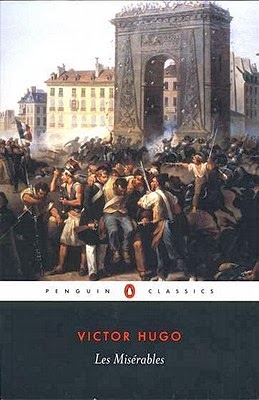
Les Misérables


Les Misérables
Victor Hugo,
Norman Denny (Translator)
5/5


Published 1862

First Sentence (Preface from Original Publisher)

"So long as there shall exist, by virtue of law and custom, decrees of damnation pronounced by society, artificially creating hells amid the civilization of earth, and adding the element of human fate to divine destiny; so long as the three great problems of the century - the degradation of man through pauperism, the corruption of woman through hunger, the crippling of children through lack of light - are unsolved: so long as social asphyxia is possible in any part of the world; - in other words, and with a still wider significance, so long as ignorance and poverty exist on earth, books of the nature of Les Miserables cannot fail to be of use."


HAUTEVILLE HOUSE, 1862


Publisher's Description:
‘He was no longer Jean Valjean, but No. 24601’
Victor Hugo’s tale of injustice, heroism and love follows the fortunes of Jean Valjean, an escaped convict determined to put his criminal past behind him. But his attempts to become a respected member of the community are constantly put under threat: by his own conscience, when, owing to a case of mistaken identity, another man is arrested in his place; and by the relentless investigations of the dogged policeman Javert. It is not simply for himself that Valjean must stay free, however, for he has sworn to protect the baby daughter of Fantine, driven to prostitution by poverty. A compelling and compassionate view of the victims of early nineteenth-century French society, Les Misérablesis a novel on an epic scale, moving inexorably from the eve of the battle of Waterloo to the July Revolution of 1830.
Norman Denny’s introduction to his lively English translation discusses Hugo’s political and artistic aims in writing Les Misérables.

Dear Reader,

This epic novel by Victor Hugo was quite surprising a treat. I think the enchantment felt was partially due to the lack of knowledge I had of this popular story. I've never seem any of the films or ventured out to see the play. Anyone who has ever read this will know Hugo tends to digress into many topics which stray from the story itself. Not knowing this, the first digression choked me like swallowing on a huge pill. But slowly, after each one... I started to enjoy his digressions and actually wanted more. Hugo has a wonderful mind and really delves into some thought provoking ideas. All this stimulating writing has me highlighting like crazy.

For example, I loved the way Hugo compared a prison to a monastery and a convict to a nun, never would I have even thought to compare the two, but what a comparison it is!! I also loved the entire rant on slang; this topic is still being debated today. The slang of long ago is proper speech today which strengthens the argument even more. He brings a refreshing look at what slang really is and how it should be treated. Progress... we must be open to it.

One of my favorite characters in the book was actually a very minor character but one which brought about Hugo's rant of slang. Gavroche, the street urchin who creates a nest in an elephant sculpture, has such cheer and resourcefulness for a child with nothing. This is admirable but Gavroche's true charm lies with his slangy speech. He speaks chock full of cute world for ordinary things and he always corrects others when they use "proper" speech. His part is short but his character is so heartwarming and odd that it stuck with me.

Okay, so... this story is aptly names, "The Miserable Wretches", be warned! EVERYONE has horrible things happen to them! However, I think a happy ending is quite overrated and usually enjoy the nitty gritty truth better. I'll leave you with this quote straight out of the ending of the book: "It is a terrible thing to be happy! how content one is! How all-sufficient one finds it! How, being in possession of the false object of life, happiness, one forgets the true object, duty!"

It was Hugo's duty to deliver us a story with depth and feeling (not one of those dull, heard it all before stories). With this, he has success... END of story.

Happy Reading,
AmberBug
Support ShelfNotes! Buy your copy of Les Misérables here:

Saturday, October 12, 2013

Horns


Horns
Joe Hill
3/5


First Sentence
"Ignatius Martin Perrish spent the night drunk and doing terrible things."
Publisher's Description:

At first Ig thought the horns were a hallucination, the product of a mind damaged by rage and grief. He had spent the last year in a lonely, private purgatory, following the death of his beloved, Merrin Williams, who was raped and murdered under inexplicable circumstances. A mental breakdown would have been the most natural thing in the world. But there was nothing natural about the horns, which were all too real.

Once the righteous Ig had enjoyed the life of the blessed: born into privilege, the second son of a renowned musician and younger brother of a rising late-night TV star, he had security, wealth, and a place in his community. Ig had it all, and more—he had Merrin and a love founded on shared daydreams, mutual daring, and unlikely midsummer magic.

But Merrin's death damned all that. The only suspect in the crime, Ig was never charged or tried. And he was never cleared. In the court of public opinion in Gideon, New Hampshire, Ig is and always will be guilty because his rich and connected parents pulled strings to make the investigation go away. Nothing Ig can do, nothing he can say, matters. Everyone, it seems, including God, has abandoned him. Everyone, that is, but the devil inside. . . .

Now Ig is possessed of a terrible new power to go with his terrible new look—a macabre talent he intends to use to find the monster who killed Merrin and destroyed his life. Being good and praying for the best got him nowhere. It's time for a little revenge. . . . It's time the devil had his due. . . .

Dear Reader,

I've been devouring Joe Hill's work ever since I discovered him. He fills a void that I've been missing within the horror genre. Maybe I need to take a break from him for a year because he is so distinctly like his father (Stephen King) in many regards, the main one being that it's very easy to overdose on his work. I used to do the same thing with King when I was younger and over the years as I aged, I knew that King is much better in small doses. The problem is... both him and his father pump out books like a crazed teen screams for their idol. I can't keep up, and nor should I. So which to read? I guess that might be the reason people review books right? To help others determine where to go next with their reading endeavors. If someone were to ask me about Horns, I might suggest this book... but only if they've stayed clear of Hill AND King for awhile.

Getting to business, the plot follows Ig (short for Ignatius) after he wakes up from a black out drunken stupor and finds horns growing from his temple. We shortly learn that he has experienced a very recent tragedy involving his girlfriends murder and to take things to the next level, Ig is secretly blamed by almost everyone in town... including his loved ones. The great thing about Hill is his imagination and he doesn't fall short with this book. Ig starts to gain powers that seem to originate from his horns, and he utilizes these to come to terms and learn the truth over his girlfriends death. The story is quite plot driven but also very lengthy (another one of the characteristics of a King/Hill book). A few parts of the book started straying away from the interesting and went a little too far into the bizarre, and I usually LOVE bizarre. I guess sometimes if the strange isn't done well, it doesn't give the story much strength.

Overall, I would say this is a solid book with a very compelling and exciting plot. Hill produces many interesting aspects to the theme of doom and death that had me thinking. He missed the mark on a few parts that had me wandering, which in the end hurt the rating. I might have liked this more if I didn't overkill the genre recently, this needs to be said for those who enjoy horror and might enjoy this more than a three star book. The last thing I want to do is dissuade someone from Horns because of my three star rating, I would actually recommend this as a good place to start with Hill.

Happy Reading,
AmberBug

Sunday, August 11, 2013

Locke & Key, Volume 1


Locke & Key, Vol.1: Welcome to Lovecraft
Joe Hill & Gabriel Rodriguez
4/5


First Sentence
"Mendocino Valley - Before"


Publisher's Description:

Acclaimed suspense novelist and New York Times best-selling author Joe Hill(Heart-Shaped Box) creates an all-new story of dark fantasy and wonder: Locke & Key.

Written by Hill and featuring astounding artwork from Gabriel Rodriguez, Locke & Key tells of Keyhouse
Locke & Key creatorHill has received the Bram Stoker Award for Best Fiction Collection, the British Fantasy Award for Best Collection and Best Short Story, and the Sydney J. Bounds Best Newcomer Award-2007, among his growing collection of critical accolades. This collection of Locke & Key, in development as a major motion picture by Dimension Films, features an introduction by Robert Crais, author of the best-selling Elvis Cole novels.

Dear Reader,

I'm not an avid comic book reader, only ocasionally and I'm usually late to the game if I decide to pick one up. This caught my attention because the creator is Joe Hill and I've become a fan after reading "NOS4A2", which I loved. The apple hasn't fallen far from the tree, Stephen King birthed his legacy and Joe Hill has taken the cup. The imagination he has is fantastic, the story is very compelling and I can't wait to read what happens next.

The comic starts tragically and the story starts to unfold backward. Each comic will reveal a little bit more of the secrets and it's really very creepy. The comic isn't for the weak of heart, it definitely has some disturbing scenes and might make an unseasoned horror reader queasy. But, for those of us who can handle the grotesque, this will be quite entertaining. I haven't been this enamored with a comic in a long time. Stay tuned for my review on volume 2...

Happy Reading,
AmberBug
Related Posts Plugin for WordPress, Blogger...